1
Communication Changes
Messages become shorter, sharper, inconsistent, vague, or harder for employees to interpret.
Discover how resilience depletion can quietly change the way leaders communicate, decide, respond under pressure, and shape the experience of the people they lead.
Recorded Aug 26, 2026 · Open the community replay room →
Watch instantly on demand. The full replay room, workbook and resources are also available inside the community.
A leader can still be showing up. Still attending meetings. Still making decisions. Still getting results.
And still be increasingly depleted.
That is what makes leadership resilience depletion so easy to miss. The first sign is not always that the leader stops performing. Sometimes the first signs appear in how other people experience the leader.
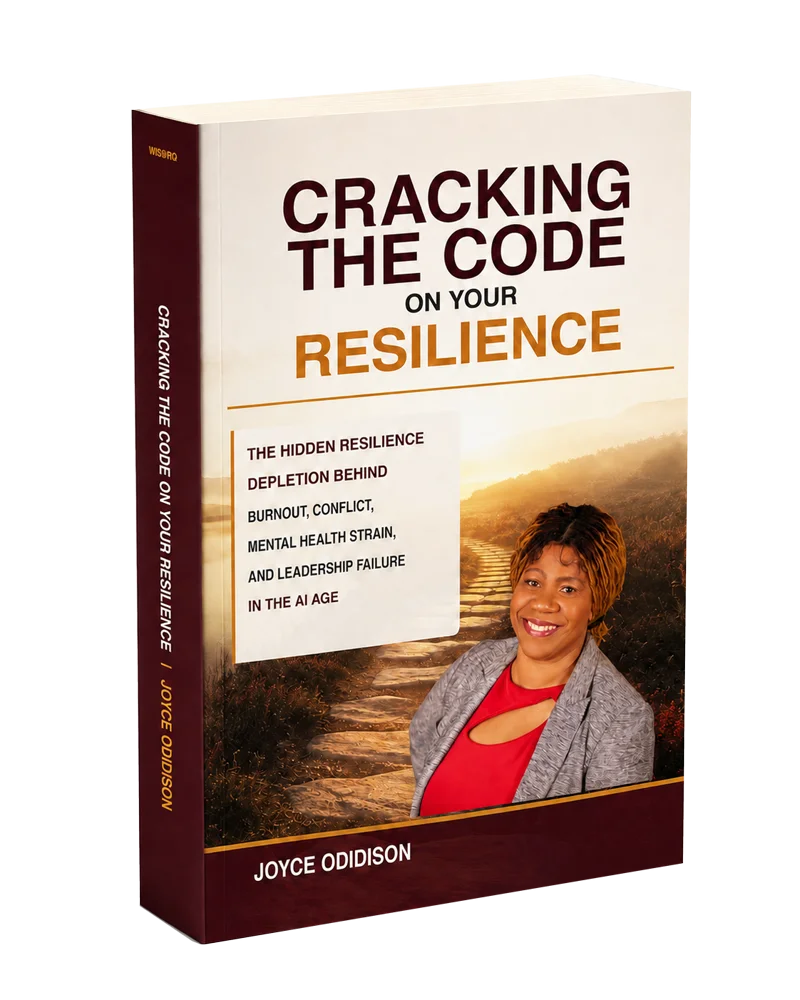
The frameworks Joyce teaches in this webinar come from her book. Cracking the Code on Your Resilience reveals how resilience depletion happens, how to recognize the warning signs, and how to rebuild the anchors that keep you grounded under pressure.
Paperback: $19.99 · Plus $9.99 shipping and handling
Secure checkout with Stripe
When a leader becomes impatient, overly controlling, avoidant, inconsistent, reactive, withdrawn, or unable to create space for others, we often focus immediately on behaviour.
Sometimes that is exactly what needs attention.
But what if the behaviour is also revealing something underneath it?
What if sustained pressure has been withdrawing from the leader’s resilience reserves, and the team is now experiencing the consequences?
“What’s wrong with this leader?”
“What pressure is this leader carrying, and what has it been withdrawing from their resilience?”
Leaders do not experience pressure in isolation. They lead people while under pressure.
Depletion can influence how leaders communicate, make decisions, handle disagreement, respond to uncertainty, create psychological safety, and sustain trust.
A leader can know the right communication strategy and still struggle to use it under sustained pressure.
They can understand psychological safety and still become defensive. They can value collaboration and still start controlling. They can believe in servant leadership and still lose the capacity to remain present.
The question is not only, “Does this leader know what good leadership looks like?”
It is also, “Does this leader currently have the resilience capacity to lead that way consistently?”
Messages become shorter, sharper, inconsistent, vague, or harder for employees to interpret.
The leader may rush, avoid, overcontrol, delay, or make decisions from pressure rather than perspective.
Employees may become more cautious, less candid, or less willing to raise concerns.
Small tensions can escalate when the leader has less capacity to regulate, listen, or hold complexity.
People begin calculating what is safe to say, when to speak, and what to withhold.
Clarity, engagement, collaboration, confidence and momentum can all begin to suffer.
In this webinar, Joyce explores how resilience can influence the way leadership styles are expressed under pressure.
A soft-edged leader may avoid the difficult conversation that needs to happen. An ego-driven leader may tighten control when uncertainty rises.
Transformational and servant leadership require more than good intentions. They require enough internal capacity to remain present, grounded, relational, and responsive while demands continue.
Resilience does not replace leadership. It supports the leader’s capacity to lead.
“The team experiences the leader’s resilience through the way the leader shows up.”
When leaders strengthen the resilience anchors and currency streams that support them, the benefit can extend beyond the individual leader.
Recognize how sustained pressure can influence leadership behaviour before performance completely breaks down.
See how leader depletion can shape trust, communication, psychological safety, conflict and team functioning.
Explore two ways leadership can shift when pressure begins to outpace internal reserves.
Consider the resilience capacity required to lead with presence, service, perspective and influence.
Understand how resilience anchors and currency streams can support a leader’s ability to function under pressure.
Explore what can happen for the leader, the team and the organization when resilience capacity begins to strengthen.
Joyce will invite you to reflect on how pressure is showing up in your own leadership, or in the leadership environment around you, and consider what those patterns may be telling you about resilience capacity.
Come ready to look at leadership through a different lens.

Joyce Odidison, M.A., MCC, CTDP, is a Conflict Analyst, Master Certified Coach, workplace resilience expert, author and founder of Interpersonal Wellness Services Inc.
For nearly three decades, Joyce has worked with leaders, teams and organizations navigating conflict, workplace pressure, leadership strain, difficult conversations and the human impact of sustained demands.
Her work led to the development of Resilience Depletion Theory™ and the Seven Resilience Anchor Currency Streams™, frameworks that help make resilience more visible, measurable and actionable.
In this webinar, Joyce draws from the leadership teaching in Cracking the Code on Your Resilience to explore what happens when resilience depletion reaches the person responsible for leading everyone else.
Discover how leadership resilience depletion can affect the way leaders communicate, decide, respond and shape the experience of the people they lead.
Look beneath the behaviour. Understand the ripple effect. See what changes when leaders rebuild.
Yes. This is a free on-demand leadership teaching experience.
No. It is relevant for executives, managers, supervisors, team leaders, HR professionals, people and culture professionals, coaches and others who support leaders and teams.
No. This webinar stands on its own and provides the context you need to follow the leadership teaching.
No. The webinar looks at leadership through a resilience lens. The goal is to better understand how sustained demands can affect leadership capacity and what becomes possible when resilience is intentionally strengthened.